Showing posts with label Branding. Show all posts

Saturday, October 10, 2009

Branding: Charisma vs. Authenticity or Charisma + Authenticity

This is a short follow-up to yesterday's post about President Obama and the Nobel Prize. I wanted to highlight two different foundations for a brand: Charisma and Authenticity.

Charisma
Charisma is based much more on fostering an emotional connection to the brand than on tangible attributes. Take "hope" for example. Hope is emotionally charged and can be an amazing catalyst. The downside is that it generally causes blind followership and buy-in. This is not to say that fans and advocates in Obama's camp are lemmings. I am a supporter and fan. The enthusiasm just needs to be tempered.


Authenticity
Authenticity is based on promoting the best of what is...not what will be. When place branding Fresno, my colleague and I focused on the six pillars identified through research that are authentic to the region. It has been difficult to find many detractors to the brand. Authenticity is also much more behaviorally based. A brand built on an authentic foundation can cause people to actually move into action by doing the things that uphold the authentic pillars.

Both/And not Either/Or
The Nobel Prize was awarded (in my opinion) based on President Obama's charisma. His goal is to authentically work for peace. It must be a both/and approach. Focusing on one or the other is not sustainable.

Charisma can rally people, but authenticity is needed to provide more than just sizzle. Likewise, building a brand solely based on authenticity make sense intellectually, but needs an emotional component. For the Fresno Brand platform, we developed a brand vision: Be World Class. Be Fresno. This is an emotional plea because the region is not at his point yet. Just as Obama built a campaign based on the vision of hope and change because the country needed those thing to look forward to.

What brands do you admire, trust, follow, support?
Is it based on the sizzle of the steak (or both)?

Related Posts

Friday, October 9, 2009

Barack Obama and the Nobel Prize: Leadership as a Brand

"Obama was selected not for substantive accomplishments, but for his 'vision' and inspiring 'hope' at the beginning of his presidency." CNN.com

Well, I awoke to a twitterverse of controversy: Barack Obama has won the Nobel Prize for Peace. Some people were ecstatic, some were skeptical, some smelled the stench of political maneuvering.

I was curious.

How could a first-term president with very few wins or successes under his belt receive such a special award?

Two years ago, Lenore Skenazy, a writer for the NY Sun, wrote a piece on branding of candidates. At that time the arguments were about Barack being "black enough" or Hillary being "feminine enough" and now some are asking if President Obama has accomplished enough.

I decided to look at this "win" from the perspective of branding, specifically personal or leadership branding. Since peace is somewhat tangible, (we know when we have peace or there are signs that a situation is peaceful) I was mostly intrigued by the reasons President Obama was awarded the Peace Prize (see opening quote). My conclusion...Barack Obama is one hell of a BRAND.


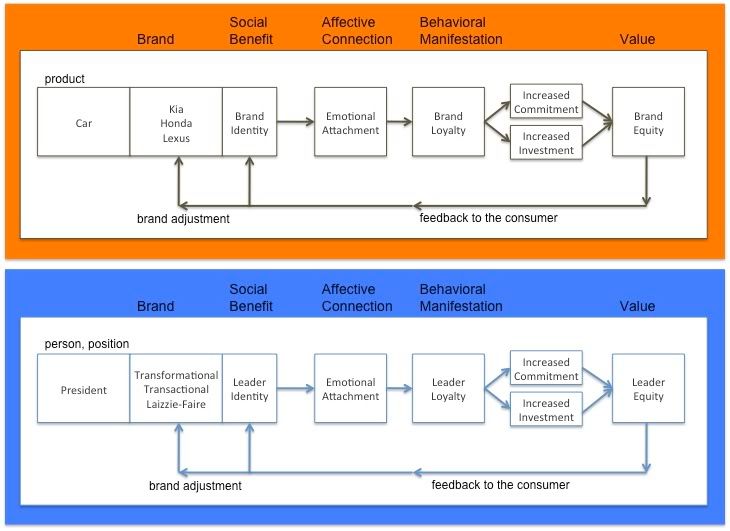
Barack's Leadership Brand can be understood by looking at five specific areas: Type of Brand, Social Benefit of Brand, Affective Connection to Brand, Behavioral Manifestation, and Brand Value.

Type of Brand
This can be considered his leadership style. Barack has proven to be a transformational leader by virtue of is ability to cast (and subsequently sell) a compelling vision. The leadership style creates differentiation. In the way a Kia is different from a Honda and a Honda different from a Lexus, leadership style contains factors that outline standards, behaviors and expectations. You expect the three car brands to be different as a result of their messaging, looks, focus, and promise. Barack's transformational style also differentiates his brand of leadership.

Social Benefit of Brand
Brand identity presents itself when people use words like "we" and "our" when talking about a specific brand. The "buyer" begins to personalize the brand. Barack Obama successfully communicated the social benefits by getting a nation to believe that "Yes We Can". People join car clubs because they want to belong to the larger collective. A good brand creates a platform for larger identity. In essence, one considers the brand's (or leader's) success to be their own success.

Affective Connection to Brand
As you can image, the next step in the process is almost a no-brainer. Once a person ties their identity to that of the brand, the emotional connection begins to solidify. This is the catalyst to brand loyalty. Barack did his with his message of "hope". If he (President Obama) is successful, then we can all be successful. Our hope and optimism is closely tied to the brand. A person is offended when someone disparages the brand because it is considered a personal attack.

Behavioral Manifestation
Oh, yes, all this identification and emotional attachment actually drives new behaviors. Behaviors of loyalty. This is marketer's dream. Brand loyalty results in two clear behaviors: Increased commitment and Increased willingness to invest. President Obama, referred to this award a call to action. Guess what, World, he is calling all of us to action (at least America). During his campaign, his volunteers set records for number of hours served. His donors gave a astounding rates. I think people are committed to, and investing in, this brand of leadership.

Brand Value
In marketing, all of the above mentioned items result in an increased brand equity (or brand value). If a person is committed to a specific brand and willing to invest more in a specific brand, the specific brand is more valuable than its competitors. Barack's brand is incredibly valuable. And guess what? That pays dividends to those who bought in early.

Impact/New Reality
Think back to the original brand, the original style of leadership. If you bought in early, you are feeling pretty good about yourself. You feel like you had a crystal ball and others did not. If you did not buy in early, but you want to now (maybe post-Nobel Prize), the cost will be higher. The brand has appreciated. For the leader, the newly earned brand equity is also helpful feedback. More people are finding value in what the leader is selling. The leader's agenda is suddenly more easily advanced. The brand is stronger.

So, back to why President Barack Obama was awarded the Nobel Prize for Peace: it was for his vision of what could be. How freaking powerful does your brand have to be to sell people on a vision of the future--not on substantive accomplishment? Getting elected was a substantive accomplishment, but not in itself Nobel-worthy.

The warning: be wary of charisma.

Barack is a charismatic leader, but let's not bestow awards based on charisma. I am a President Obama supporter, but I think this award is a bit premature. While I think it is premature, I can see, from a branding perspective, why he won. He has sold the world on his vision.

Dear President Obama,
Please deliver on your brand promise. A lot of people have increased their individual commitment and willingness to invest. Brand loyalty is high. Now is the time to accomplish something substantive.


Wednesday, October 7, 2009

Google & the Mark of the Beast?

SEE UPDATE AT THE VERY BOTTOM

So, I have joked for a long time that Google could be the anti-Christ (well, them or Apple). But today my greatest fear, the fear instilled in me by my Great Uncle Bob a fire and brimstone preacher, was confirmed when I opened Chrome. Google's logo was replaced with a bar code. People have long thought that the mark of the beast was going to be in the form of a bar code. The bar code was introduced to the mainstream in the mid-seventies during the height of the Jesus movement. The Jesus Freaks got scared and paranoia was born (wonder if the pot they were smoking could have caused some of that paranoia?).

Now this post is not a ploy to generate hits to my blog in a "talk-about-Google-and people-will-click-through sort of fashion. My Twitter buddy, Dennis, already warned about the impact of name dropping on a blog. His recent Intel post caused an amazing spike, but was not intentional. Hey, us bloggers love Google Analytics, right?

I want my posts to add some value or at least be thought provoking.

So think about this: How strong does a brand need to be to remove its logo?

This post is more about the power of the Google brand. Raise your hand (figuratively) if you have sipped the Google Kool-Aid? You know who you are...you have a gmail account or use Google Chat or are hoping to be picked to play with Google Wave or carry an Android or...or...or. What was once a cool little search engine has quickly risen to rule the Internets. People are clamoring to join the Google cult and then the "chosen" feel blessed and immediately start to share the good news--the Google Gospel, if you will. The brand is so strong that they can afford to replace their logo, their brandmark, with whatever they please. You know a brand is strong when they can take away the iconic image and actually increase the equity.

This level of brand power is not of this world. It is obvious that Google is Satan incarnate. The end times are among us.

I jest, but I want you to consider this...Since most brands want to achieve success in Googlepic proportions, what are they doing to strengthen their brand without selling their soul to the devil?

Damn, Google is hella strong. They can be completely open about their relationship with Beelzebub.

UPDATE: Further evidence of Google's evil intentions can be seen in its palindrome stock symbol: GOOG. Any good cult seeks to control your thoughts and actions. Look closely at the stock symbol. Google is telling you to GO this way --> and that way <-- OG. It's as if the word "GO" is admiring itself in the mirror (vanity and conceit are other traits of the anti-Christ). We find our way around the internet because Google controls where we GO...That is probably why they launched Chrome (control your browsing) and will soon release a full operating system (control how we operate).

Thursday, September 10, 2009

Marketing Lesson from High School: The Prom


When I was in High School I was pretty much a big dork. The first two years were hell, but finally by my senior I had blossomed into less of a dork. Like most kids I was not comfortable in my skin, did not have a clear understanding of my identity, and desperately wanted to be liked. The challenge was that I didn't know why people should like me...I just thought that they should.

This is the same thing I see facing businesses today:
They are not comfortable in their industry.
because they don't spend the introspective time as a student of the industry
They lack a clear understanding of their identity.
because they want to be everything to everyone
They desperately want to be liked.
because if people like them then they will generate income

Just like trying to secure a prom date, businesses need to walk their potential date through the buying process: Population, Awareness, Preference, Engagement, Retention.


Population - All the people on campus
In my high school there were approximately 3000 people on the campus. If I assume half of them were females, that create a pool of 1500 possible prom dates...not too bad.
  • How big is your market? Don't say it's everyone on campus unless you are really willing to entertain offers from the guys and the gals.
Awareness - All the people who know me
Like I said, I was not that popular. I played sports early in my high school career, but that stopped when I started working. So I can conservatively guess that 300 female students knew me....the number is starting to drop.
  • Sure a lot of people exist, but how many of them know about you? They gotta know you before they are gonna like you. Sometimes it pays to be popular...but being popular does not necessarily mean being liked.
Preference - All the people who have a positive opinion of me
I did a lot of stupid stuff in high school. You know what they say about a bad customer service experience...upset one person and they will tell eleven others. Well, that caused my pool of candidates to shrink even more. Now I was down to 75 gals from which to choose. I didn't protect my brand very well.
  • The catch: They know you and like you. Just because someone has heard about you does not mean they like you. Some people (and businesses) are popular for all the wrong reasons. You know who that girl or guy was on campus.
Engagement - All the people who are willing to go to the prom with me
Well, I waited until two weeks before the prom to start my search. Many ladies already had dates, many decided not to go, many were willing to go with me, but I was not that desperate. So now I was down to 12 prospective dates. There were 3000 people on my campus and I had to select from the Dirty Dozen.
  • Are they willing to buy or just smiling in your direction? Bad timing and poor closing skills leaves a lot of opportunity on the table. You can increase your odds by recognizing when a person is ready to say "yes" and actually make your move.
Retention - All the people who are willing to go out with me again
I surveyed the options, asked one gal, she said yes. The problem was that it was a bad date. The muffler fell off my car. I insulted my date's religion. I made a fool of myself at dinner. She wasn't "into dancing". I gave her a High Five good night. It wasn't pretty.
  • Do you have a plan to keep them coming back for more? Sometimes you want to marry your high school sweetheart. If she has a bad prom experience, the wedding bells probably will not happen. What is your retention strategy?
What happens when someone has a bad experience? They tell eleven others...there goes the Dirty Dozen.

Monday, August 10, 2009

buildabrand.com: a foolish man builds his house upon the sand

I remember a cute song from Sunday School that said:
A foolish man builds his house upon the sand. A wise man builds his house upon a rock.

It was a metaphor describing the importance of a solid foundation. Hey, we all want a cool house right on the beach, but there are a lot of fools in southern California. Buildabrand is offering some good beachfront property.

A recent Techcrunch article seems to prematurely sing the praises of buildabrand.com. Wrong approach to branding. You are allowing a single individual to provide input when the process does not allow for input from the prospective audience...the actual user of the brand. I do believe the nuts and bolts will spit out a cool image and type suggestion, but it is another example of cheapening the definition of a brand. Why not call this "Build an Identity" instead of build a brand.

A true brand is build on foundational principles and not points and clicks.

I know the resources for start-ups are very limited, and many cannot afford to hire a brand guru to get into the minds of the audience to develop a snazzy logo. That is the problem: Brand gurus miss the mark sometimes and sell visual identity as branding. They are different.

Think of branding as a giant (I mean GIANT) umbrella. The visual representation is but only one panel of the umbrella. I work with entrepreneurs who think that image is everything (still trying to believe Andre Agassi) and who cares about substance...

I CARE DAMMIT!!!

I want to experience brands. I want to define them as the consumer. I want to know about the brand's foundation. I don't want to know how the VP of Marketing for ACME defines the brand. He probably will get it wrong.

Sorry to rain on the buildabrand.com parade. I would be very interested to see what would happen if the Build-A-Bear company used the buildabrand.com solution...it would create a DIY vortex.

Can buildabrand.com provide an actionable platform or just neat icons complete with a little shine and reflection?


Wednesday, August 5, 2009

Branding & Burning Man Lesson #4: Connect: Let Go Your Ego

Accountants. Doctors. College Professors. College Kids. Yuppies. Hippies. They were all there. They all looked exactly the same. So much for differentiation, right? Actually, the consistency of similarities was the key differentiator. From all walks of life and philosophical bents, people interacted. They interacted freely without prejudice and without expectation. They only goal was to connect and share.


This seems to be a hard concept for some people to wrap their minds around—even harder for brand gurus. At Burning Man the focus was outside of self and within self at the same time. Now, you gotta stick with me on this point. The reward came in connecting with everything…more than just people. In fact, the people were kinda annoying sometimes. Yeah, I said it. But the point was not to necessarily connect person-to-person. The point, as I saw it, was to simply connect. Connect with the art. Connect with the elements. Connect with the stress. Connect with the isolation. Even connect with the vastness of nothing. To accomplish this, the ego had to be checked at the front gate…


…sidebar: Within 30 seconds of driving through the front gate, I witnessed male and female nudity…This is why the connection must exist beyond people. You cannot attend thinking it’s “Girls Gone Wild: Black Rock City Edition.”


Brands need to check egos as well. Sometimes a brand is developed by one of the aforementioned gurus with a certain value or connector in mind. Marketing dollars are poured in and results only trickle out. Where is the connection? Like Burning Man, the connection needs to come from multiple points. Avoid the obvious. The obvious touch point (like the nudity at Burning Man) is usually less compelling.


Gurus need not apply, and here is why: Gurus like to make it about them. Look at the awards on my wall. Look at the profits in my company. Look at the fancy office with a lot of glass and metal. Gurus want you to connect with them and not them with you. If I had that attitude at Burning Man, then I would have missed out on all the cool art. I would have only looked for things that I knew would appeal to me. I wanted the similar differences that surrounded me to make me think. When I was able to enjoy that connection, it no longer was about me or you or them. It was about the freedom of the connection. Hey, money people, don’t you want the market to have a strong connection to your brand? Then stop making it about you. It’s very freeing.


Additional Chapters
Connect
Give (coming soon)
Protect (coming soon)
Educate (coming soon)
Go (coming soon)
Final Thoughts (coming soon)

Thursday, July 23, 2009

Build Brand Equity on Twitter: Same Crap as Real Estate Market

So we are all pretty familiar with the housing crisis. Yeah, nobody saw it coming. Then everyone was the smartest guy/gal in the room because they totally saw it coming. With the benefit of hindsight people recognized that the same antecedents that led to the dot-bomb were evident in the roof collapsing on the housing market. Now I want to be the “smartest guy in the room” and make the connection between the real estate market and Twitter. That’s right, people, I said it. Don’t believe me? Check out these four levels of comparison.

Moving into more house than you need…but I’ll grow into it.
Some marketing genius told you that Twitter is this cool new neighborhood. The price is right and the opportunity is huge. It may seem overwhelming at first, but you’ll get used to it. Like that new house with a bigger yard and way too much square footage to be useful, Twitter is appealing because the price per square foot is great. Why not go all out? Who cares if you don’t know how to care for the bigger house? Who cares if it is stretching your resources to maintain it (I thought Twitter was free).

You were convinced that the market was right for the move, not because you were ready for the move, but everyone else was upgrading to this cool new neighborhood so you should too.

Do you even qualify?
When the real estate market started taking off, all of these tools entered the market to make sure people could qualify for the home of their dreams. Remember? Interest only, ARM, Stated income, 80 first + 20 second, Zero down. People laughed if you actually bought a home with a 30-year fixed rate mortgage. Hell, people couldn’t qualify based on credit worthiness, so the market changed the credit vehicles.

Twitter is facilitating the creation of tools in the marketplace that allow
brand to be managed with very little money down. Let’s automate everything. People are not Web 2.0 or Twitter worthy, but let’s get them a tool so they can at least get in the game.

Then the market will change and the rates will adjust. The truth will be exposed and those who should have not been in the space will be ousted.

Sure you got in during “phase I” but, my how the neighborhood has changed.
I have noticed that freaks are all over Twitter. It’s like a nice neighborhood that goes to shit because the wrong element infiltrates. This sounds harsh, but when the wrong mix in a neighborhood exists, the sense of “community” is compromised. As with my last point, making tools available so every dumbass can explore the Twitterverse is very annoying. I’ve signed in a number of times to my Twitter account, looked around, and said to myself, “Well, there goes the neighborhood.”

In the housing market’s hay day, people from all walks of life were moving into neighborhoods with little regard to cultural or value alignment. People/brands are also doing this on Twitter. When a negative element infiltrates, the founders/early adopters of the neighborhood begins to change its behavior. Heck, sometimes they leave and subsequently change the original dynamic that made the neighborhood attractive in the first place.

Building equity the wrong way.
The housing market gave people a false sense of worth—financial and social. If a person earned $50k per year in salary and was able to (easily) pull $20k out of their house each year to fund a new pool, vacation, boat, car, etc., then they were living as if they made $70k per year. When the ATM (their home’s equity) dried up, they were left is a situation of having a $70k lifestyle on a $50k budget. What to do? What to do? They did not build equity by paying down the principle (hell, they probably financed 125% of the purchase price just to get things started). They built equity by relying on automation. The equity in the housing market was automated. Don’t believe me? How else can you move into a house, make no improvements, pay nothing toward the principle, and actually generate equity? Automation.

Twitter is now doing the same thing. Maybe not Twitter itself, but the Twitter real estate market. Followers can be automatically added because of weak similarities. Toys R Us started following me the other day because I mentioned the store in a single tweet. Really? I will probably not mention them again…will they unfollow me? Probably not. Twitter equity is being fabricated by adding followers and following others. But where is the real value.

I am not an alarmist, but I do see Twitter becoming less effective. Can it do more? Yes. But that was the pitch to move into a bigger house. Some of you who made the move probably looked around the new digs and said, “We can host family holiday dinners here,” or “Look at this backyard. We won’t have to take anymore vacations,” or “This is the last house we will ever need…it’s perfect.” Then the bottom fell out. Beware…Twitter is getting shaky.

Tuesday, July 14, 2009

Branding & Burning Man Lesson #3: Experience: Maximize Every Rotation


Okay, I only had four days to fully experience Burning Man. As I mentioned previously, I hit the ground running and didn’t waste a single minute. After the long drive, I knew I was going to be ready to stretch my legs, hop on my bike, and get to it.

Now, a lot of stuff goes on at Burning Man. It is quite hedonistic to say the least. Sins of the flesh abound, but Burning Man is not a free love orgy. It is about removing the barriers of everyday life that keep a person tied to the expectations of others—at times, the expectations of our own doing.

Expectations keep us from experiencing some of life’s simple and purest pleasures. Expectations keep us from maximizing each rotation of the earth. The earth rotates every 24 hours. In general, that breaks down to 8 hours of sleep, 8 hours of work, and 8 hours of other stuff (play, chores, commuting, appointments, etc). At Burning Man that allocation is allowed to adjust. That really changes the experience.

Brands are created based on one set of expectations but are experienced based on another set. Internal expectations (even if based on stellar research) generally shape the brand’s initial incarnation; however, the marketplace is quick to make modifications. The marketplace wants to maximize its experience with the brand. Why shouldn’t they? They bought it. The marketplace does not want to be
told that the brand is best experienced 8 hours here, 8 hours over there, and 8 hours way over there. The end user wants to be just that…the end user. That is to say, they want to experience the brand as it best suits them.

So take a look at the Burning Man experience…let the end user feel like they only have a finite amount of time with the brand. Let them determine how it is best experienced. Let them decide how each rotation will be spent.

Next thing you know, the end user will be deeply connected to the brand. It’s about them; it’s not about you. Your ego will survive.


Additional Chapters
Experience
Give (coming soon)
Protect (coming soon)
Educate (coming soon)
Go (coming soon)
Final Thoughts (coming soon)

Wednesday, July 8, 2009

Branding & Burning Man Lesson #2: Trust: Fire Purifies. Fear Paralyzes.

It is hot and dry on the playa. I mean really hot and really dry. I do not know how much water (okay, not enough water, but ample amounts of Rock Star and alcohol) I consumed, but I do not remember going pee the whole time I was there. I just kept sweating. Heat is a constant at Burning Man. I mean, the event ends with a blaze of fire. The burning of the man was cool, but there was another purposeful fire out on the playa—the burning of the Temple of Forgiveness.


The Temple was a wooden structure that people visited to let “things” go—issues, pains, opinions, losses, ideals, fears, etc. The idea was to write your “thing” down and place it at the Temple. Later in the week, the Temple was burned and your “thing” was burned with it…allowing you to move forward with a fresh start.

Visiting the Temple was powerful. There were people crying, laughing,
connecting. I placed my own “thing” on the Temple. It felt good. It was a burden that kept me frozen. I was afraid to share it with people. I was afraid to expose it. I was afraid.

The Temple was just a wooden structure. There was nothing magical about it. The magic was in the process. I had to trust the process. I had to acknowledge that fire purifies and fear paralyzes. This is true for a person and true for a brand.

Fire Purifies.
Some people don’t like to set fire to their “things” and I content that some brands try to avoid fire as well. A brand will be built and launched. The market will interact with the brand and imperfections will surface. A smart brand manager will use the fire of the marketplace to continue to refine and purify the brand. The market--the user--is a brand’s fire. Trust that the users know how to best purify your brand. After all, the market is ultimately the definer of a brand.

Fear Paralyzes.
Some people are frozen in time as a result of their “things.” Brand suffer the same fate. I have even seen an unnatural fear to launch a brand based on the assumed market response. If that is the case, there are two options: 1) internal fire and purification, or 2) external fire and purification. Either way, paralysis is not helpful.

The heat of Burning Man provided a lot of trust opportunities. As I trusted more people, the playa, myself, I came to enjoy the experience more and more. Look at every fire that is available and seek to purify the brand. I was there for a limited amount of time, just as brands have a limited lifespan, and I wanted to maximize my experience. I knew trust was going to play a key role in that. And what an experience it was…


Additional Chapters
Trust
Give (coming soon)
Protect (coming soon)
Educate (coming soon)
Go (coming soon)
Final Thoughts (coming soon)


Thursday, July 2, 2009

Branding & Burning Man Lesson #1: Arrive: Come Home. Come Live. Come Enjoy.

So the 10 hour drive was the beginning of the adventure. The top was completely off the Jeep and it rained the night before the journey. Actually, it was still raining the morning of the trip. No worries. It's about adventure. On the drive to Black Rock City, it rained most of the way to Sacramento, was 108 degrees in Sacramento, rained and hailed through the mountains into Nevada, and then there was the dust of the playa. Perfect. All this was necessary. It was all part of the experience. My experience. Remove any one element and the experience would be different from the start.

This leads me to think about brands. Where do they come from (or do sound smart, from where do they come)? Burning Man is about arriving and experiencing. Can brands be built and understood the same way?

Come Home.
You have to consider the playa "home" while at Burning Man. It is your environment--your new 90201 or Kansas or Harper Valley. Brands must be built so people can "own" them, bask in them, turn them into a home. They need to be inviting regardless of the journey to get there. In fact, the more difficult the journey (rain, heat, hail, dust), the more refuge the brand must provide. Refuge does not mean shelter. Refuge means safety and acceptance. A brand must meet the personal need of the explorer.

Come Live.
So maybe I did something wrong when I arrived at the Devil's Bunghole. I set up camp (made myself at home) and instantly jumped on my bike to experience the playa. I was told that I needed to take it slow and acclimate to the ways of the playa. I wanted to go and go fast. So I did. Brands have to be livable. They have to be ready for people to jump in without fully acclimating to the brand.

Come Enjoy.
That first night rocked. There were art cars, lots of FREE booze, friendly (very friendly) people, and multi-sensory stimulation. Everywhere I looked I was seeing something cool. I was fully enveloped in Burning Man. I know that a particular brand is generally designed to meet a particular need. But I think brands can fully envelop a person. I should be able to find enjoyment on multiple levels. This is very important as a person first interacts with a brand: I bought brand X for this purpose, but look at how it has positively impacted this other area of my life. Burning Man was full of positive unintended consequences.

Come Home. Come Live. Come Enjoy. Each were important as I first arrived at Burning Man. It is also important to note that I had my own set of expectation of what would occur when I arrived on the playa. I had my own definition of home, live, and enjoy. It was up to Burning Man to meet, fail to meet, or exceed my expectations. This is more than a Burning Man or branding philosophy...this is a way to approach life. Assimilating these lessons in other areas requires a lot of trust, but that's a story for another day.

Additional Chapters
Arrive
Give (coming soon)
Protect (coming soon)
Educate (coming soon)
Go (coming soon)
Final Thoughts (coming soon)


Tuesday, June 30, 2009

The Best Lesson of Branding was Learned at Burning Man

Ever been to Burning Man? It is crazy. It is an event in the middle of nowhere (a place I call the Devil's Bunghole...no offense Burning Man gods). Every year upwards of 40,000 "Burners" converge on the ancient lakebed and build Black Rock City. For about week, a city--which has a larger population than my hometown--exists and hedonism ensues. The coolest thing about Burning Man is the absolute lack of commerce. Everything (other than ice and coffee) is exchanged via gifting. No commerce, no formal government. Nothing exists in that godforsaken lakebed outside of Black Rock City. But during the period of time Black Rock City exists, it is freaking amazing. I went in 2007 for just four or five days (I honestly cannot remember) to experience the Green Man (the theme for 2007).

So how did I learn about branding in an environment where commerce and commercialism are seriously frowned upon? Well, I contend that you can learn a lot about one thing by studying its opposite. Over the next few weeks I am going to discuss the ways in which Burning Man and Branding (personal and product) are aligned. The hippies at Burning Man are gonna hate this. The suits in the corner office are gonna hate this. Hell, I will probably even hate it. Sometimes the truth is inflammatory (intentional Burning Man pun). I can say truth because it is true to me. I will support my claims with pithy anecdotes and some facts...

The important thing is to start a discussion and introduce a new way of thinking about branding, about oneself, about commerce, about the Devil's Bunghole known as the playa. Here's a taste of what I'll discuss:
While you wait, do me a favor. Think about how you would behave if you were accustomed to living in a capitalistic environment and were suddenly thrown into the Devil's Bunghole. Would you enjoy the freedom or freak out due to the lack of structure?